
Backhand Drive Secrets: How to Use Your Elbow and Wrist
On the backhand side, power does not come from a big swing. It comes from two small engines: the elbow and the wrist. In this lesson, Captain Yasser Yehia — professional table tennis coach in Riyadh — shows you how these two small moves make your backhand drive technique fast and controlled.
(This is Lesson 6 of the basics series. It builds on Lesson 5 — the Backhand Drive guide.)
The Elbow Is the Axis
In the ready position, your elbow stays a little away from your body — this lets you switch fast between forehand and backhand.
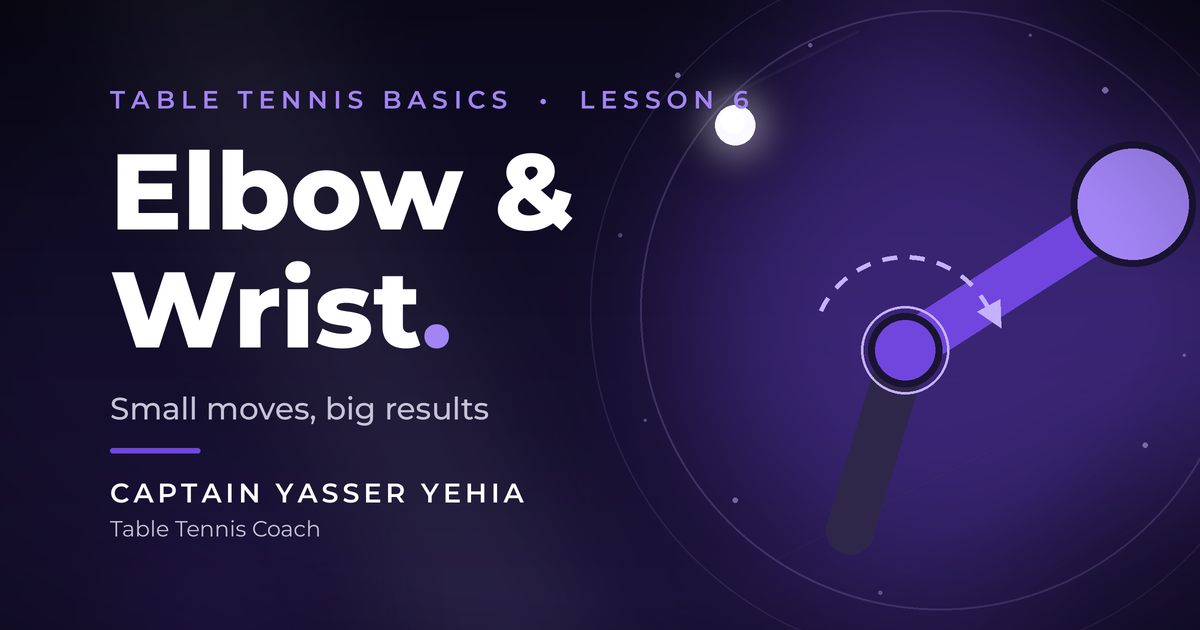
For the backhand drive, the elbow sits in front of the body, not glued to it. And here is the secret: during the stroke, the elbow keeps its place. It is the axis of the movement — the forearm turns around it like a door around its hinge.
If the elbow jumps around, the stroke loses its shape and its control.
The Wrist: Back, Then Release
The wrist works in two steps:
- In the backswing: the wrist tilts back a little, and the racket face is a little closed.
- At the contact: you release the wrist — you straighten it exactly at the moment of the hit. This small release adds speed and control at the same time.
One warning: the wrist is a fine tool. Small movement, big effect. Do not whip it wildly — one clean release is enough.
Why the Swing Must Stay Short
The backswing of the backhand drive goes only to your waist / left hip — no further. A short, controlled swing means:
- You are never late to the ball.
- You recover fast for the next shot.
- The elbow can do its job as a stable axis.
A long backswing or a long follow through breaks all three.
2 Simple Drills
Drill 1 — The quiet elbow (mirror):
Stand in the ready position in front of a mirror. Do 10 slow backhand shadow swings. Watch your elbow: it should stay in its place while the forearm moves. Then do 10 at normal speed.
Drill 2 — “Back… release”:
Do a slow shadow swing and say the words out loud: “back” (the wrist tilts back) — “release” (the wrist straightens at the imaginary contact point, in front of your body). Repeat 15 times. This builds the timing.
Train with Captain Yasser Yehia in Riyadh
Details like wrist timing are hard to feel alone — and easy to fix with the right eyes watching. Captain Yasser Yehia corrects these small details live in his private and group training programs in Riyadh.
FAQ
Should my wrist be loose or firm?
Relaxed but controlled: a small tilt back, then one clean release at the contact.
Where exactly should my elbow be?
In front of the body, a little away from it — and it keeps its place during the stroke.
Why do my backhands go into the net?
Often the racket face is too closed, or the contact is too late. Meet the ball in front of you, at the top of the bounce.