
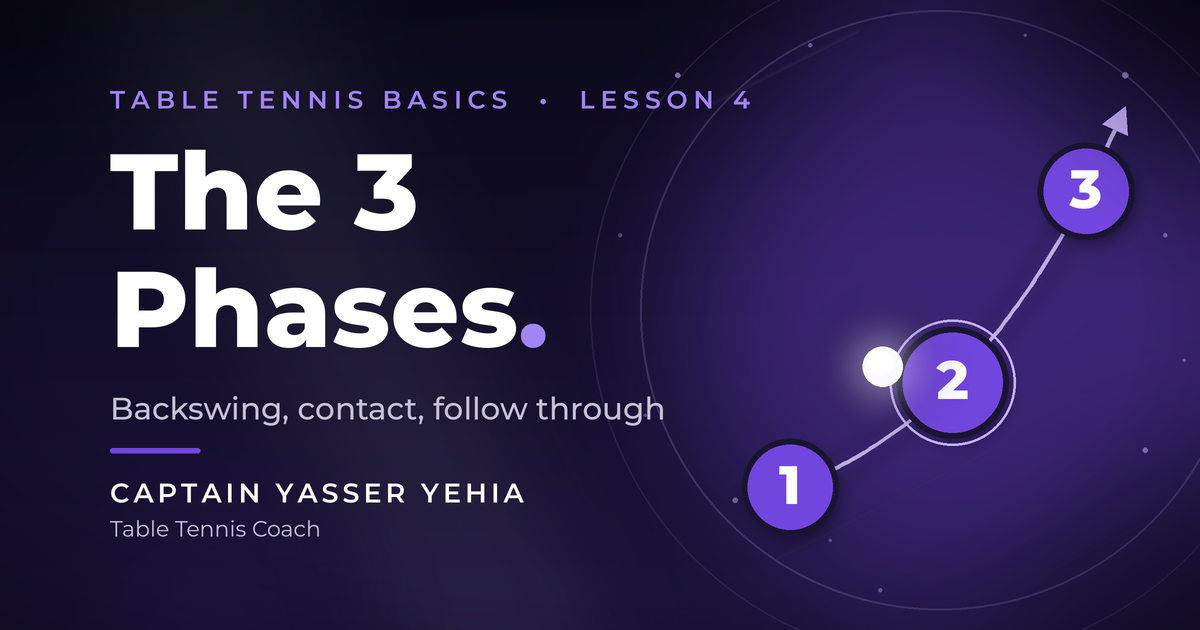
The 3 Phases of the Forehand Drive: Backswing, Contact, Follow Through
Every good forehand drive is really three small movements, one after the other. Master each one, and the full stroke becomes easy. In this lesson, Captain Yasser Yehia — professional table tennis coach in Riyadh with more than 21 years as a player and 13 years as a coach — breaks the forehand drive technique into 3 clear phases.
(This is Lesson 4 of the basics series. New to this stroke? Read Lesson 3 — the full Forehand Drive guide — first.)
Why Learn the Stroke in 3 Phases?
Because it makes learning simple, and fixing problems fast. When your ball goes into the net or flies long, the problem always lives inside one phase. Find the phase → fix the problem. This is exactly how coaches analyze a stroke.
Phase 1: The Backswing — Load, Don’t Swing
The goal of this phase: prepare your body. You are not hitting yet.
- From the ready position, turn your body a little to the right (left-handed players: to the left).
- Move part of your weight to the back leg.
- Pull the hitting arm back a little.
- Open the shoulder and the waist a little.
- Keep the racket head up — do not drop it low.
The most common error here: a backswing that is too big. A big backswing feels powerful, but it makes you late. Small and ready beats big and late.
Phase 2: The Contact — The Power Chain
The goal of this phase: meet the ball at the perfect point, with the whole body.
- The movement starts from the legs → then the hips → then the body → then the arm.
- Your weight moves forward.
- The arm travels forward and a little up.
- The contact is in front of your body, at the top of the bounce or a little before it.
- The racket face is a little closed (tilted forward), depending on the ball.
Phase 3: The Follow Through — Finish and Reset
The goal of this phase: end in balance and be ready again.
- The racket continues forward and up after the contact.
- The body ends balanced, with the weight forward.
- Return immediately to the ready position.
A good follow through is natural, not forced. Do not stop the racket at the ball — and do not swing it to the sky.
The Power Chain, Explained Simply
Legs → hips → body → arm. Think of it like a wave: the legs push, the hips turn, the body follows, and the arm arrives last — fast and light. If you start the movement from the arm, you break the chain and lose the power. This is why, in Captain Yasser Yehia’s lessons, the forehand always starts from the legs. The arm only finishes the work.
A Simple Shadow Drill (No Ball Needed)
- Stand in the ready position in front of a mirror.
- Say the phases out loud: “One — turn. Two — hit. Three — back.”
- Do 10 slow swings, then 10 at normal speed.
- Check in the mirror: small backswing → contact in front → balanced finish.
Train with Captain Yasser Yehia in Riyadh
Reading about the phases is step one. Feeling them with real balls, at real speed — that is where a coach changes everything. Captain Yasser Yehia builds this technique step by step in his private and group training programs in Riyadh.
👉 Enroll Now (button → link to your Enroll page)
FAQ
Which phase is the most important?
They work together. The contact decides the ball — but a bad backswing ruins the contact before it starts.
Where exactly should I meet the ball?
In front of your body, at the top of the bounce or a little before it.
Why do I lose balance after the shot?
Your swing is probably too big. Keep the follow through short and finish with your weight forward.